


 Sign in
Grouping and Raids
Grouping is how players in World of Warcraft team up: a party of up to five for quests and dungeons, or a raid of up to 40 for the hardest content in the game. Classic's endgame is built around raids, and the systems guilds built to run them, from loot rules to DKP, shaped how a generation of players thought about online games.
Parties
A party is up to five players. Its leader invites members, sets the loot rules and can mark targets with raid icons so everyone knows what to kill first. Party members share experience from kills made near each other and share credit for most quest kills, and they see each other's health and mana on the screen.
Most dungeons in Classic are built for a full party of five: usually a tank to hold monsters' attention (see Threat), a healer, and three players who deal damage. Classic has no tool that builds groups automatically. Players found each other by asking in a city's trade channel or a zone's "LookingForGroup" channel, by word of mouth, or within their guild. Getting a group together and walking to the dungeon could take as long as the run.
Raids
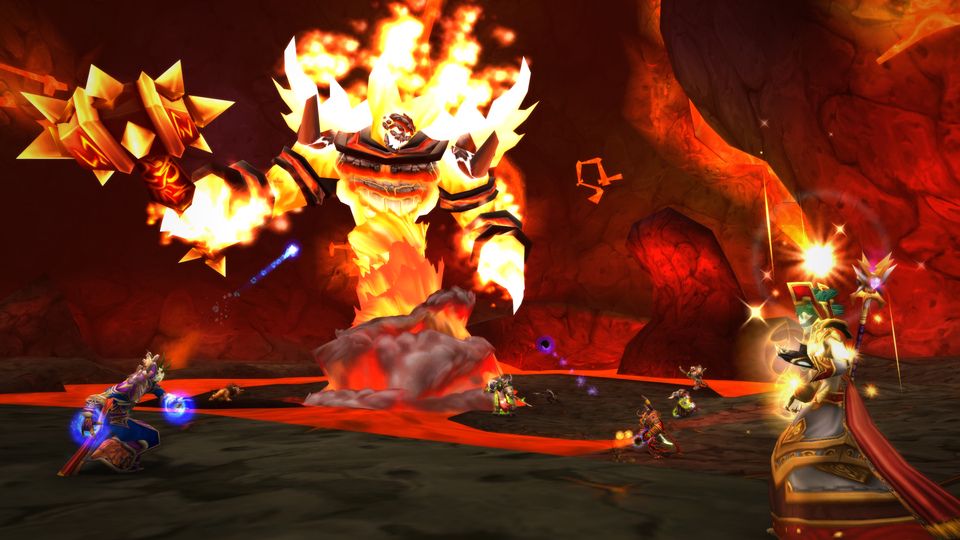
A party leader can convert the party into a raid, which holds up to 40 players in eight groups of five. Members of a raid still share buffs and spells that affect a party only with their own group, so raid leaders arranged groups with care, putting a shaman's totems or a paladin's auras where they did the most good.
Classic's raid instances come in two sizes:
- 40 players: Molten Core, Onyxia's Lair, Blackwing Lair, Temple of Ahn'Qiraj and Naxxramas.
- 20 players: Zul'Gurub and Ruins of Ahn'Qiraj.
Upper Blackrock Spire is a smaller step up, a dungeon for 10 players. Outdoor world bosses such as Azuregos and Lord Kazzak also called for raid groups. Most normal quests cannot be finished while in a raid group, so players had to leave the raid to turn them in.

Lockouts
Killing a raid boss saves a player to that raid's ID. Until the raid resets, they can only go back into that same copy, with the bosses they already killed still dead. The 40-player raids reset once a week, Onyxia's Lair every five days, and the 20-player raids every three days. A 40-player guild could clear a raid only once a week, which set the rhythm of raiding life: a few fixed raid nights each week, with everyone expected to attend.
Loot rules
The party or raid leader chooses how loot is shared:
- Free for All: anyone can loot anything.
- Round Robin: players take turns looting each corpse.
- Group Loot: items above a quality threshold, uncommon (green) by default, are rolled for by everyone. Each player chooses Need, Greed or Pass, and Need beats Greed.
- Master Looter: one player, usually the raid leader, hands out every item above the threshold.
Five-player groups usually used Group Loot. Raids used Master Looter so the guild could decide who got each item.
DKP and other systems
With 40 players and only a few items from each boss, raids needed a fair way to decide who got what. The best known answer is DKP, "dragon kill points", which guilds brought over from EverQuest. Each player earns points for attending raids and killing bosses, and spends them on items, often by bidding. A player who comes every week builds up points to spend on the items they want most.
There were many variations. Zero-sum DKP divides the cost of each item among the raid. "Suicide Kings" keeps a list and sends whoever takes an item to the bottom. Loot councils let a few officers decide based on attendance and need. Some guilds rolled. Arguments over these systems ended friendships and split guilds, and DKP became part of the culture of the game, as the joke in the Leeroy Jenkins video about "fifty DKP minus" shows.

Later history
The Burning Crusade cut raid sizes to 10 and 25 players. Later expansions added the Dungeon Finder and Raid Finder to group strangers automatically, personal loot so that each player gets their own drops, and flexible raids that scale to the group. Classic Era and WoW Forever keep the 1.12 rules.
Sources
Categories: Game Mechanics
Comments (0)
No comments yet.