


 Sign in
Corrupted Blood Incident
The Corrupted Blood incident was an accidental plague that swept through World of Warcraft in September 2005. A damaging debuff meant to stay inside the new Zul'Gurub raid escaped into the open world on players' pets, spread from player to player in the capital cities, and killed thousands of characters before Blizzard reset the servers. Because players reacted to it much as people react to a real epidemic, it later became a case study for epidemiologists.
How it started
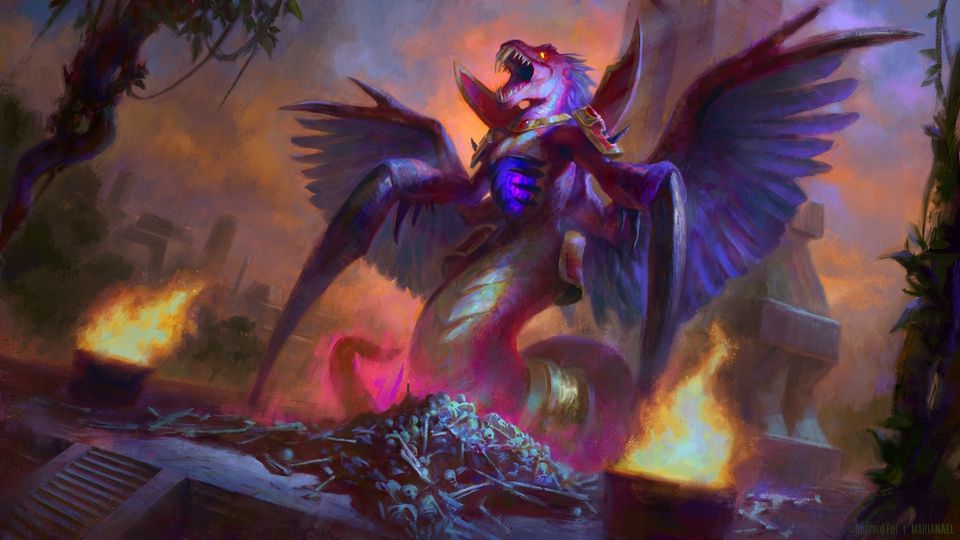
Zul'Gurub opened on September 13, 2005. It was a raid for 20 players in Stranglethorn Vale, and its final boss was Hakkar the Soulflayer. During the fight Hakkar casts Corrupted Blood, a debuff that deals damage over time and jumps to anyone standing nearby. The intended design was that it would last only a few seconds, or end when Hakkar died, and that it stayed inside the instance.


The flaw was pets. Hunters and warlocks could dismiss an infected pet during the fight and call it back out later, and the pet would still carry the debuff. Nothing removed it once the raid ended. When players returned to the cities to repair gear, their pets brought the infection with them, and it spread to every player who came close.
The outbreak
The debuff dealt 263 to 337 damage every two seconds, enough to kill even a level 60 character in about 30 seconds. Each death also cost equipment durability, so a trip through an infected city was expensive.
Non-player characters in the cities caught the debuff too. They did not die from it, so they acted as carriers that kept reinfecting players. Ironforge and Orgrimmar were among the worst-hit places, with corpses piling up in the streets.


Players responded in ways that looked very familiar to disease researchers:
- Avoidance. Many players left the cities and stayed in the countryside, using chat to warn each other which towns were infected.
- First responders. Healers ran into the cities to keep others alive, and often died themselves, since only paladins could remove the debuff and reinfection was almost immediate.
- Warnings. Some players stood at city edges and told travelers to turn back.
- Deliberate spreading. Griefers carried the debuff into crowds on purpose.
- Rumors. Misinformation spread fast, including the belief that Blizzard had started the plague on purpose.
Blizzard's response
On September 16 Blizzard said it was aware of the problem and working on it. It tried quarantine zones, which players ignored or bypassed, and then hotfixes and rolling restarts, but the plague returned each time an area filled back up. After about a week, Blizzard hard-reset the servers to clear the debuff. A patch on October 8, 2005 made pets immune to Corrupted Blood.
When Zul'Gurub returned in World of Warcraft Classic in April 2020, pets were immune from the start, and there was no repeat outbreak.

Interest from epidemiologists
The incident drew attention from public health researchers because it was a large, unplanned outbreak among real people making real choices, something mathematical models usually have to assume.
- The US Centers for Disease Control and Prevention asked Blizzard for data. Blizzard said the outbreak was a bug and it had no data suitable for disease modeling.
- In 2007, Ran Balicer wrote in the journal Epidemiology that infected pets resembled animal carriers of avian influenza, and that fast travel between cities resembled how air travel spread SARS.
- Also in 2007, Eric Lofgren and Nina Fefferman argued in The Lancet Infectious Diseases that online worlds capture individual human choices that standard models have to assume. They also noted the plague's limits as a model: its reproduction number was far higher than any real disease, and infected players gained no immunity.
- Counterterrorism researcher Charles Blair suggested that the behavior of griefers could help in thinking about deliberate attacks.
Other researchers were skeptical that a game outbreak, with no real consequences for players, says much about real epidemics. The incident drew renewed press attention in 2020 during the COVID-19 pandemic, when Lofgren compared the in-game healers who rushed to help to overwhelmed real-world health workers.
Later history
Blizzard later ran deliberate plagues. In October 2008, a zombie plague event before the Wrath of the Lich King expansion let players infect each other on purpose; Blizzard ended it after about a week following player complaints. The Shadowlands pre-launch Scourge invasion in 2020 was designed as opt-in to limit griefing.
Sources
- Corrupted Blood incident, Wikipedia
- Deadly plague hits Warcraft world, BBC News, 2005
- World of Warcraft Gets Plagued, IGN, September 22, 2005
- The untapped potential of virtual game worlds to shed light on real world epidemics, Lofgren and Fefferman, The Lancet Infectious Diseases, 2007
- Modeling Infectious Diseases Dissemination Through Online Role-Playing Games, Balicer, Epidemiology, 2007
- World of Warcraft Shines Light on Terror Tactics, Wired, 2008
- What a WoW virtual outbreak taught us about how humans behave in epidemics, Ars Technica, 2020
- Zul'Gurub is live in WoW Classic, but Corrupted Blood doesn't plague Azeroth, Blizzard Watch, April 14, 2020
Categories: Game History
Comments (0)
No comments yet.