


 Sign in
Death and Resurrection
This is revision 1, from Oct 29, 2026 04:23. See the current page.
Death in World of Warcraft is a setback, not an ending. A character who dies becomes a ghost, and can return to life by running back to their body, by paying a spirit healer, or by being brought back by another player. Classic's rules make each death cost time, money or strength, and the long run back from the graveyard, the "corpse run", is one of the most familiar experiences in the game.
Becoming a ghost
When a character dies, each item they are wearing loses 10% of its durability, and the player is offered the choice to release their spirit. Doing so moves them as a ghost to the nearest graveyard, where a Spirit Healer waits. The world turns grey, the ghost can pass through monsters unharmed and moves faster than a living character, and night elves become a wisp that moves faster still through Wisp Spirit.
From there the ghost has two choices.
The corpse run
The ghost can run back to its body. An arrow on the minimap points the way. Once close enough, the player can come back to life on the spot, with half their health and mana. There is no further cost, which is why most players take this option, even when the body lies deep in a dangerous zone.
In a dungeon or raid, the ghost appears at the graveyard outside and must run back to the instance's entrance, then walk through the portal to come back to life just inside it. A raid that wipes deep in Molten Core or Blackrock Depths can spend several minutes on the run back, and graveyards placed far from an instance's entrance were long-running complaints.

The spirit healer
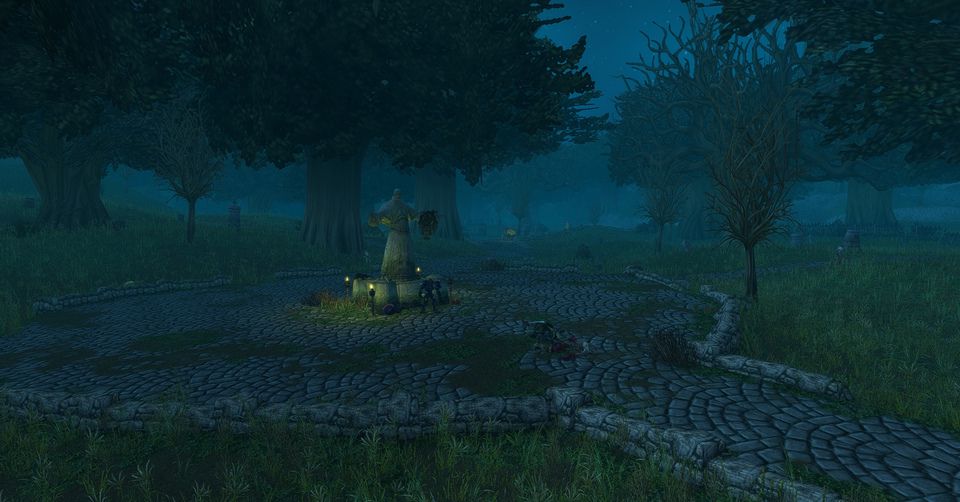
A ghost can instead ask the spirit healer to bring them back at the graveyard. That costs more: every item the character owns, worn or carried, loses another 25% durability, and characters above level 10 get Resurrection Sickness, which lowers their health, mana and stats by 75% for up to 10 minutes. Players use the spirit healer when their body is out of reach, such as at the bottom of a lake or in the middle of an enemy camp, or when they plan to repair and rest anyway.
Spirit healers in battlegrounds such as Alterac Valley and Warsong Gulch work differently: they bring every waiting ghost back together every 30 seconds, at no cost.

Resurrection by other players
Several classes can bring a dead player back where they fell, saving the run:
- Priests cast Resurrection, paladins Redemption and shamans Ancestral Spirit. None can be cast in combat.
- Druids cast Rebirth, the only resurrection usable in combat, on a 30-minute cooldown and with a reagent.
- Warlocks make a [Major Soulstone] and place it on a friendly player with Soulstone Resurrection. If that player dies within 30 minutes, they can choose to come back on the spot. Raids place soulstones on healers before a hard fight.
- Shamans with Reincarnation can bring themselves back once an hour, using up an [Ankh] bought from reagent vendors.
- Engineers can use [Goblin Jumper Cables] or [Goblin Jumper Cables XL], which work some of the time.
After a wipe, a raid's usual plan is for the soulstoned player to return, rest, and resurrect the others in turn.
Repairs
Durability loss is the real price of dying. Items at zero durability stop giving their stats until repaired, and repairing a full set of raid gear costs several gold. Guilds counted repair bills as part of the cost of progression, and some paid them from the guild's treasury.
Later history
Later expansions changed little about the basic rules: corpse runs, spirit healers and resurrection sickness all remain. Later expansions gave more classes a way to resurrect in combat and limited how many times a raid can use them per fight. In Classic Hardcore, none of this applies: a character who dies is dead for good.
Sources
Categories: Game Mechanics