


 Sign in
Alchemy
Alchemy is the crafting profession that turns herbs into potions, elixirs, flasks and oils, and turns one metal into another through transmutation. In Classic it was the profession raiders could least do without: every serious guild needed alchemists for healing and mana potions, fire protection potions for Molten Core, and the flasks that defined endgame preparation.
What alchemy does
An alchemist works anywhere with a stack of herbs and a few vials bought from a trade supplier. Most recipes produce consumables: things a player drinks or applies and then loses. That makes alchemy different from the armor and weapon professions. A blacksmith's best work is sold once and worn for months, while an alchemist's potions are used up every night, so there is always a market for them.
Alchemy's products fall into a few groups:
- Potions restore health or mana instantly, or give a short effect such as [Free Action Potion] (immunity to stuns and movement impairment) or [Limited Invulnerability Potion] (immunity to physical attacks). Potions share one two-minute cooldown, so a player can drink only one in a fight every two minutes.
- Elixirs give a stat or ability bonus for an hour, like [Elixir of the Mongoose] for agility and critical strike, [Elixir of Giants] for strength, or [Greater Arcane Elixir] for spell damage.
- Flasks are two-hour, high-powered elixirs whose effect lasts through death. Only one flask can be active at a time.
- Transmutes turn materials into rarer ones, most importantly a [Thorium Bar] and an [Arcane Crystal] into an [Arcanite Bar].
- Oils and utility items, such as [Oil of Immolation] and [Elixir of Water Breathing].
Trainers and skill ranks
Alchemy follows the four Classic ranks. Apprentice covers skill 1 to 75 and can be learned from any alchemy trainer at level 5. Journeyman (up to 150) needs level 10, Expert (up to 225) needs level 20, and Artisan (up to 300) needs level 35. Every capital city has an alchemy trainer for the first three ranks, but Artisan training is only offered by a handful of people:
- Ainethil in Darnassus and Doctor Herbert Halsey in the Apothecarium of Undercity, the two artisan trainers.
- Rogvar in Stonard in Swamp of Sorrows and Kylanna Windwhisper at Feathermoon Stronghold in Feralas, master alchemists who teach the high-end recipes.


Many important recipes are not taught by trainers at all. They come from vendors, such as [Recipe: Transmute Arcanite] sold by Alchemist Pestlezugg in Gadgetzan and [Recipe: Major Healing Potion] from Evie Whirlbrew in Everlook, or they drop in dungeons.
Leveling route in outline
Alchemy levels on herbs the alchemist usually picks personally, so most players train Herbalism beside it. A common route through Classic:
- 1 to 60: [Minor Healing Potion] from [Peacebloom] and [Silverleaf], the starting herbs of every zone.
- 60 to 140: [Lesser Healing Potion] and then [Healing Potion], using Briarthorn and Bruiseweed from the level 15-25 zones.
- 140 to 185: Swiftthistle and Kingsblood recipes, ending with [Greater Healing Potion].
- 185 to 225: [Elixir of Fortitude] and mana potions from Goldthorn and Khadgar's Whisker, the herbs of Stranglethorn Vale and the Hinterlands.
- 225 to 275: [Superior Healing Potion] from [Sungrass] and [Khadgar's Whisker], then [Dreamless Sleep Potion] and Elixirs of Detect Undead.
- 275 to 300: [Major Healing Potion] from [Golden Sansam] and [Mountain Silversage], or [Major Mana Potion] from [Dreamfoil] and [Icecap].
Because every high-level recipe needs the same few herbs, prices for Mountain Silversage, Dreamfoil and Plaguebloom rose and fell with raid nights on every server.
Flasks
The flasks were the most prestigious products in Classic. There were five:
| Flask | Effect | Recipe from |
|---|---|---|
| [Flask of the Titans] | +1,200 maximum health | [Recipe: Flask of the Titans], dropped by General Drakkisath in Blackrock Spire |
| [Flask of Distilled Wisdom] | +2,000 maximum mana | [Recipe: Flask of Distilled Wisdom], dropped by Grand Crusader Dathrohan in Stratholme |
| [Flask of Supreme Power] | +150 spell damage | [Recipe: Flask of Supreme Power], dropped by Ras Frostwhisper in Scholomance |
| [Flask of Chromatic Resistance] | +25 resistance to all magic | [Recipe: Flask of Chromatic Resistance], a rare world drop |
| [Flask of Petrification] | Immunity to all damage, but no actions | [Recipe: Flask of Petrification], a rare world drop |
Every flask needs a [Black Lotus], the rarest herb in the game, and must be made at an alchemy lab. In Classic only two places qualify: the lab in the room of Ras Frostwhisper in Scholomance, and one inside Blackwing Lair past Broodlord Lashlayer. An alchemist with flask recipes had to clear part of a dungeon or raid to brew, which kept flasks expensive. The workbench in the Undercity Apothecarium does not count.
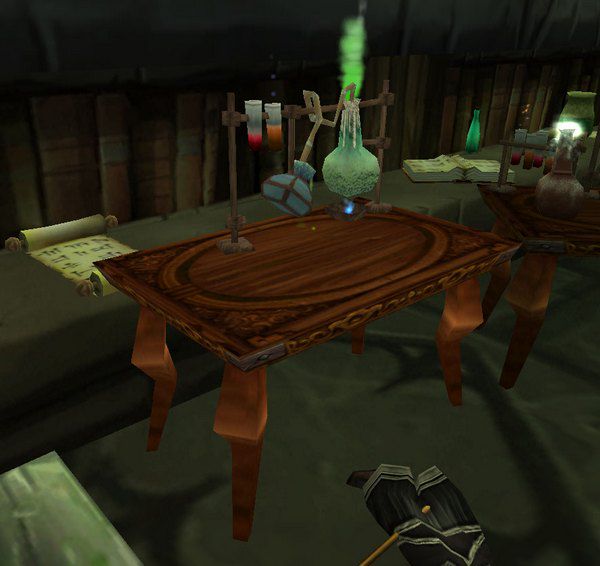

Flasks were most important in the hardest content. Tanks drank [Flask of the Titans] for progression bosses, and some guilds required flasks for attempts on Nefarian, C'Thun and the Naxxramas bosses.
Transmutes and the Philosopher's Stone
Transmutation needs a [Philosopher's Stone], which alchemists make themselves. The early transmutes, such as Transmute: Iron to Gold and Transmute: Mithril to Truesilver, are useful to blacksmiths and engineers. The important one is Transmute: Arcanite: one [Thorium Bar] and one [Arcane Crystal] become an [Arcanite Bar]. Arcanite Bars are needed in large numbers for the best crafted weapons and engineering items, including twenty for Arcanite Reaper. Because the transmute has a long cooldown, arcanite was always scarce, and alchemists could sell their daily transmute to blacksmiths for a good price.
Elemental transmutes, which turn one essence of fire, water, earth, air or undeath into another, became important for the raid gear that needed specific essences.
At 300 skill, alchemists can make the [Alchemists' Stone], a trinket that makes healing and mana potions 33 percent stronger for its wearer and that only an alchemist can use.
Alchemy in the economy
Alchemy has no specialization in Classic; that came with The Burning Crusade. It was a common choice for raiders and gold-makers alike. Raiders saved money on potions they burned through every week, and herbalist-alchemists could sell their surplus. Its best-selling products changed with the raid calendar: [Greater Fire Protection Potion] before every Molten Core and Blackwing Lair run, [Mighty Rage Potion] for warriors, [Greater Stoneshield Potion] for tanks, and [Major Rejuvenation Potion] for everyone else.
The most common pairing is Herbalism, since every recipe uses herbs. Some players instead pair alchemy with a second crafting profession and buy their herbs, but that costs more gold over time.
Sources
Categories: Professions
Comments (0)
No comments yet.